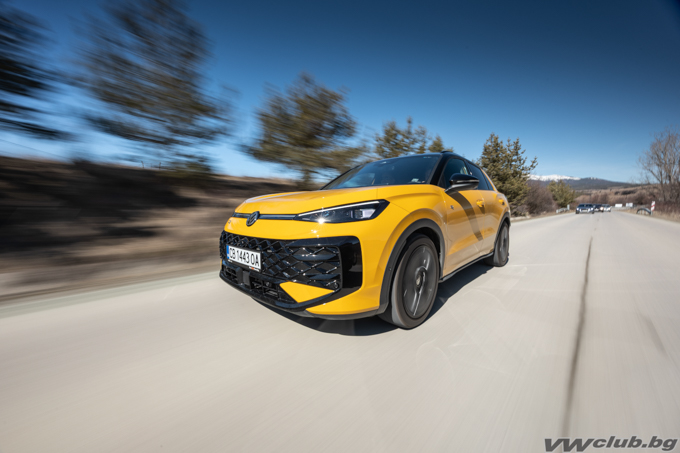
T-Roc 2026 Test Drive
Last weekend we had the chance to test-drive the new T‑Roc. The model was launched in Bulgaria at the end of 2025 and impressed us visually right at the premiere. Volkswagen's new design language probably suits the T‑Roc best. The headlights are slightly "frowning", the bumper is wide and aggressive, and together they give the car a very dynamic look. By now almost every media outlet has tested it and said everything from the point of view of an ordinary user. But we are not just users: we are fans. So we will share our point of view.
We tested the top trim of the model, in Pomelo Yellow, a bright, rich yellow metallic paired with a black roof that looks like piano lacquer. The colour replaces the older Turmeric Yellow of the first-generation T‑Roc. An interesting fact is that the new generation can be ordered with wheels up to 20 inches, while the previous one was offered with 19-inch wheels at most.
The space surprised us as soon as we got in. From the driver's seat the T‑Roc makes you feel you are driving a bigger car. When you close the door you immediately notice there is no standard door handle: the opening mechanism is built into the armrest grip itself, which feels unusual at first but you get used to it quickly. Looking ahead over the bonnet reveals a clear resemblance to the Tiguan. The steering wheel is comfortable, with physical buttons (thankfully) and a perfect rim thickness. We set off through the busy streets of Sofia, and the proven 1.5 eTSI (Mild Hybrid) paired with the 7-speed DSG gearbox moves the car with ease. From the high driving position the car feels confident in the city, helped by the large mirrors. The test car had 360-degree cameras, which together with its length of 4.37 m made parking in the centre of the capital much easier. On the second day we decided to take it to Samokov and see how the T‑Roc behaves where a car like this shines most: on the road to the mountains. Luckily for the T‑Roc, there were a few slower machines from Stuttgart on the slopes, and we decided not to embarrass them. The combination of engine, electric assistance and the short-geared 7-speed gearbox gives smooth, even acceleration across the whole rev range, as if the torque were a straight line. The test car did not have the new DCC, but despite the 19-inch wheels the ride was surprisingly good. The car is firm but not hard. Through the bends towards Samokov and then towards Malyovitsa the T‑Roc behaved superbly, with minimal body roll. On the roads of the Samokov valley the four passengers enjoyed full comfort. Although it has grown only a little on the outside, the T‑Roc has grown a lot in sound insulation: even on a wet, snowy road you hear and feel absolutely nothing inside. The T‑Roc steers lightly, precisely and directly, and I expect it to cover long journeys with ease. Another plus of the light steering is how quickly you get used to the car, which is sure to appeal to anyone who gets behind the wheel. On the way back we drove in the dark, and the new IQ.LIGHT LED Matrix headlights with cornering light made the trip effortless. We also drove it on the motorway, where we tested the latest-generation Travel Assist with active lane change, and the assistant did a great job.
To finish, we have to be honest: we were a little sceptical about the car, but after the test we definitely liked it! We are looking forward to the second half of 2026, when all-wheel-drive versions (2.0 eTSI, 204 hp) will be available, as well as the top-of-the-range T-Roc R with 333 hp…